
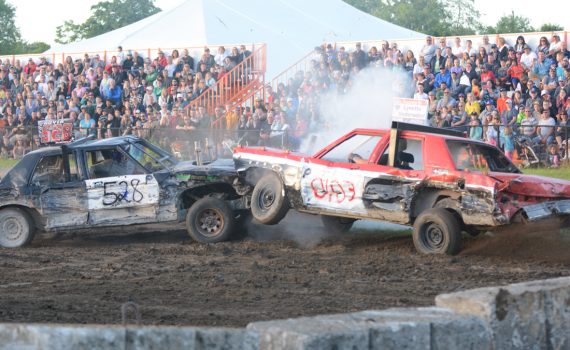
Demolition Derby
Ready to get smashed? Come join us Thursday & Saturday at the Fair to demolish some cars and trucks!
Proudly sponsored by:
Elite Roadside Inc.
Shipton Mechanical Repair
Dom's Auto Parts
Bennett PowerSports
The Tamara and Nikki Team Right at Home Realty
CB Pools & Spas
OGS Landscape
Mattamy Homes
BONUS: due to overwhelming success each year we welcome back for a 8th year the Kids Power Wheels Derby!
2026 BROOKLIN SPRING FAIR DEMOLITION DERBY
PRESENTED BY:
IDF Promotions
Committee Chairperson: TBC
Entry fee: $60 per heat, Pit passes $5. 4-vehicle minimum for full pay-out
DEMOLITION DERBY SCHEDULE
Thursday June 4, 2026
Start Time - 7:00** pm (Kids Power Wheel Derby 6:45 pm)
Tech and sign in opens at 4:00pm
**All classes EXCEPT Power Wheels - Power Wheels heat will take place during drivers meeting at 6:45 p.m. All drivers must attend driver's meeting at 6:45 p.m.)
Thursday Purse: $2500
Classes:
1. | Thursday: Kids Elimination Power Wheels |
2. | Thursday: Demo Cross Event |
Saturday June 6, 2026
Start Time - 6:15** pm (Kids Power Wheels Derby 6:00 pm)
Tech and sign in opens at 3:30 pm
**All classes EXCEPT Power Wheels - Power Wheels heat will take place during drivers meeting, Power Wheels start – 6:00 p.m. All drivers must attend the drivers meeting 5:45pm start. **
Saturday Purse: $6000
3. | Saturday: Kids Elimination Power Wheels |
4. | Saturday: Full-Size Cars |
5. | Saturday: Light Weld Mini |
6. | Saturday: Junk Run |
7. | Saturday: Youth Mini Cars |
QUESTIONS – Contact the IDF Promotions at dustin6210@hotmail.com
Rules and Entries:
Be sure to review both the general rules AND the rules for your class to avoid disqualification!
Standard Rules (All Heats):
Coming soon.
Demo X Rules
1. RIDING ON CAR: Insurance Regulation: No person riding on outside of cars at any time. All drivers and pit person MUST sign in when arriving at the event and the online insurance waive
2. FLAMMABLE MATERIAL: Please remove sun visors
3. TRAILER HITCH:
4. GLASS/Must be removed and all sharp edges must be mashed down prior to derby event. Pickup truck MUST have rear mud flaps min 8” long. All windows, mirrors, lights, airbags & trim, must be removed prior to derby event. Windshield may be left in place to protect driver.
5. DOORS & NUMBERS: An optional roof number plate may be securely installed.
6. FIRE EXTINGUISHER: Must minimum of 2.5 lbs and be within reach of the driver, must work and have a working gauge.
7. BATTERY: One 12 volt car battery may be moved to front passenger floorboard/seat and securely fastened in a box/container clear of all fuel sources. Following inspection it must be covered with a non-flammable shield OR left in stock position under the hood and covered with a rubber mat.
8. GAS TANK: Stock gas tanks may be removed. Must be a steel marine tank, custom steel fuel tank, or certified racing fuel cell. All tanks must be securely fastened down (bolted) in the middle of the back-seat area. Tank must be covered with a non-flammable material after inspection. Maximum 3 gallons gas OR stock tank can be left in stock position if not rusty. Referee has final decision. If left in stock position it is recommended that an additional strap be added to hold tank in place. No plastic tanks.
9. FUEL LINES: All fuel lines must have leak proof fitting with steel or rubber lines (no clear lines). No exceptions.
10. FUEL SYSTEM: Electric fuel pump must be isolated with a non-flammable material covering lines, tank & pump. Non-flammable covering may be fire resistant blanket or air bag material.
11. HOOD: A 12” opening must be cut in hood over the center of the engine. Hoods must be held down in a minimum of 2 places with seat belts, chain, wire, bolts or weld. No overuse of materials.
12. TRUNK: Trunk, rear hatch or tailgate SHOULD be held down in a minimum of 2 places with seat belts, chain, wire, bolts or weld. No overuse of materials.
13. BODY PANELS Metal may be cut from around wheels for clearance. Front & rear quarter panels may be bolted with up to 5 bolts per panel – maximum 3/8” bolts.
14. DOOR FASTENING: Driver’s door may be welded solid. All other doors must be fastened shut with wire, straps, chain, welds or bolts. No overuse of materials. Solid driver’s door window screens are not allowed. Mandatory that the driver’s door be fastened closed in minimum 4 places
15. BRACING: Outside of car may have a 12” X 60” X 1⁄4” max steel plate MUST be applied to drivers & passenger doors if passenger is inside car, bolted in 4 locations (with a maximum 3/4” through bolt) & spot welded 1” every 12”. Bevel should not exceed 20”. NO “C” CHANNEL OR ANGLE IRON. Not mandatory.
16. ROLL BAR: Single roll bar up each doorframe, inside or across outside of the roof. Roll bars going across the roof must be through bolted twice through the roof for driver & spectator safety. This roll bar may be welded or bolted to the frame or rockers. An additional bar may be added behind the seat welded or bolted from roll bar to roll bar. Recommend 3″ to 4″ square tubing or pipe. No excessive use of materials. Not mandatory. Extra bars inside the car may be used for driver’s safety. Not Mandatory.
17. WINDSHIELD SPACE: Windshield area may have a safety cage or bars running from the cowl to the roof. Windshields may be left in place. If windshield is removed a bar must be put in place in the driver’s windshield area for driver’s safety.
18. DASH BAR: Not Allowed
19. INTERIOR MODIFICATIONS: No welding of any inside body support seams or firewall seams. All holes in firewall must be covered with a non- flammable material. Large holes in car floors must be repaired with same gauge metal and securely fastened. No reinforcement.
20. BUMPERS: Bumper shocks may be reinforced with flat bar or tubing to help keep bumpers on. Excessive use of material will be asked to be removed. Mandatory that both front and rear bumpers are tied up with wire or seat belt in minimum of 2 spots. Stock bumper to vehicle.
21. FRONT GRILL: Stock A.C. condensers permitted in original position. RADIATOR: Must be flushed of anti-freeze and replaced with water only.
23.TRANSMISSION COOLER: high pressure lines and fittings must be used .
24. SUSPENSION: Suspension must remain stock (movement must occur). Broken or sagging parts may be replaced. It is recommended that rear coil be wired or welded to differential. Rear ends can be exchanged Gears may be welded. Steering columns, drive shafts and rear sway arms may be altered but not reinforced. Ball joints, tie rods, control arms and steering linkage must remain stock. NO REINFORCING ALLOWED. No truck rear ends in cars. No off road suspension permitted. Stock like suspensions. Strut blocks allowed 6” long MAX
25. HEADERS: Must be secure, must point upwards and not at other drivers/spectators. Must be a reasonable length or will be asked to be cut or removed. Official’s discretion.
26. FRAMES: No welding of frame seams top or bottom. Rusty or bent frames may be repaired with steel plates 4”x4”x1/4”. Over repaired frames will be considered reinforced and will result in alteration or disqualification. Official’s discretion. No painting of frames except for the following. Frame repairs must be painted bright orange before arriving for derby event. All repairs to frames must be reported to officials before inspection – over-repaired frames will be asked to be cut – if not – may result in disqualification.
27. DRIVETRAIN PROTECTORS: Not Allowed
28. MOTOR MOUNTS:Stock mounts may be welded or chained. Any excessive or added mounts will result in disqualification.
29.TIRES: lTires must be low aggression. Drive tires must be filled with air only. Tires may be doubled. No split rims. No studding. All wheel weights must be removed. Any rim , No outside beadlocks . Carry spare mud tires in case track conditions warrant. Referee’s discretion. NO OVER AGGRESSIVE TIRES on drive wheels. No triple side walls on drive wheels. Tire tread over 1/4“ deep might be rejected.
Kids Power Wheels Rules
Coming Soon.
Full Size Car Rules
- Any year 6- or 8-cylinder hardtop automobile or station wagons over 109” wheelbase. NO trucks, convertibles, jeeps, vans, Imperials, hearses, limousines, checker cabs or suicide Lincolns. NO ALL-WHITE CARS.
- NO all-wheel drive deleted vehicles i.e. Subaru, Volvo, trucks, convertibles, jeeps, vans, hearses, limousines, or checker cabs.
- Cars previously ran may be considered too battered and unsafe, resulting in disqualification. If there is in any question regarding the participant’s vehicle it is the driver’s responsibility to prove make, model, year, engine etc.
- NO ALL-WHITE CARS
PREPARATION OF CAR
- REMOVE OR CONVERT THE FOLLOWING PRIOR TO ARRIVING AT FAIRGROUNDS OR TRACK
MANDITORY SAFETY REQUIREMENTS
- BRAKES: Vehicles MUST have dependable brakes and must be working properly before entering the RING and at all times. Pinion brakes are allowed as long as the bracing for the brake assembly in no way reinforces the rear end housing. All boundaries MUST be observed
- BATTERY: Battery must be moved to front passenger floorboard/seat and securely fastened in a box/container clear of all fuel sources. One (1) single car battery. Following inspection, it MUST be covered with a non-flammable shield such as air bag or rubber mat. No heavy truck / equipment batteries.
- GAS TANK: Stock gas tanks must be removed. Steel marine tank, custom fuel cell or certified racing fuel cell ONLY. All tanks must be securely fastened (bolted) down in the middle of the back seat area. Gas tank may be mounted to the post-to-post bar. Gas tank protectors are allowed MAX size is 30’’ outside dimensions this is to protect tank only not to reinforce the car. Protector cannot touch the floor or roof of the car. Can have 2 total straight gusset tube from halo to the GTP. These tubes will not be included in the 30’’ max dimension. Tank must be covered with a non-flammable cover after inspection (air bag, floor mat). No movement can occur during inspection. Any leaks will result in disqualification. NO UNSAFE FUEL TANKS. NO “JERRY CANS”. OFFICIALS DECISION IS FINAL.
- FUEL LINES: All fuel lines MUST have leak proof fitting with steel or rubber lines (no clear lines). No exceptions. Lines should run inside the car. Leaks will result in disqualification. All connections MUST have hose clamps to eliminate leaks. If your fuel system is not safe you will not run.
- FUEL PUMP: MUST have a safety shut off switch marked in red located in center of windshield or dash area for officials use. Switch to control fuel pump only. Driver’s safety. MANDATORY. This rule is for fuel injected cars only, does not apply to carbureted cars. MUST be able to be seen by flag staff from 20’ away.
- INTERIOR & EXTERIOR OF VEHICLE: All carpet, headliner, door panels and ALL other flammable material MUST be removed from inside of the car. Front seat and dashboard may be left in place. All glass, mirrors & mouldings must be removed. All air bags must be removed. Front and rear bumper covers MUST be removed. MANDITORY minimum of 2.5lbs fire extinguisher with working gauge MUST be securely mounted and within reach of the driver. Please check gauge on extinguisher before arriving at the event.
BODY PREPERATION:
- DOORS: All doors must be wired, chained, strapped or welded if welded you may use 4’’x 4’’ x ¼’’ plates 16 per side of vehicle. Drivers’ door may be welded solid. Drivers’ door must be reinforced you may use a 12’’ x 72’’ x ¼’’ side plate a full door skin or a steel drop sheet inside the door. Recommended way for mounting drop sheet is to bolt through the outer door skin the drop sheet and inner door shell using a minimum of four ¾’’ bolts. It is also recommended that the driver uses an old foam sofa cushion/seat cushion between the driver and the door. u may also use a interior bar that is part of your cage. Please find cage specifications below. Passenger side door protection is your choice. NO C CHANNEL OR ANGLE IRON ON OUTSIDE.
- TRUNK/TAILGATE : Trunk lid MUST be in stock position or removed. Trunk may be tucked in the centre of the trunk area 90° or dished. No other modifying or manipulating of the trunk. Rear quarter panels and taillight pockets are to remain vertical on fresh cars NO rolling them over. NO WEDGED TRUNKS ALLOWED.
Trunk/tailgate may be fastened shut in a max of 8 places using wire, chain, strapping or welded using 4’’ x 4’’ x ¼’’ plates. If the trunk is fastened shut before tech a 12” inspection hole is required. 2 x ¾” threaded rod in trunk/tailgate is allowed but MUST be in the trunk lid NOT the speaker deck area. If adding threaded rod in original body mount, you must leave the rubber spacer or one hockey puck per mount in place. Unlimited #9 wire on a USED car no wire allowed in the drivers , passenger or front windshield area these three windows are to remain clear for escape or rescue in case of emergency.
- HOOD: Hood must be in stock location no moving forward, backwards or rolling hood over face of rad support. Hood may be removed without hood – use electric fan only – fans directly connected to motor must be under sheet metal of hood. A 12” opening must be cut in the center of the hood. Hoods to be fastened in MAX 8 places using chain, strap, wire or belts. You may also use 2’’ x 2’’ x 2’’ long angle iron welded to the fender & hood with one 3/8’’ bolt and nut per angle. Hood may be bolted in 2 places with MAX 3/4″ bolts or threaded rod. These bolts can go through the hood, rad support, and frame, must have rubber bushing, hockey puck or steel tube max 3’’ to 6’’ tall per side. These will count for 2 of the 8 places fastening hood closed. You may run 9 wire from hood to front bumper but these wires will count as part of your 8 allowed hood closers. HOODS MUST REMAIN OPEN TILL YOUR CAR PASSES INSPECTION
- SHEET METAL: Metal may be cut from around wheels for clearance. Six 3/8’’ bolts with store bought washers are allowed per wheel well bolts need to be cut off flush with the outside of the nuts. Body peening is allowed.
- BODY MOUNTS: Stock mounts and bolts must remain in place. If bolts are broken or rusted you may replace with factory size bolts and factory store bought washers for that size of bolt. Ie. 7/16’’ No increasing bolt or washer size.
- WINDSHIELD/REAR WINDOW AREA: Front windshield MUST have a 1 single steel bar, or chain bolted to cowl and front of roof. This bar cannot connect to the rollover bar. No rear window bars. No 9 wire in any windows. Sunroofs MUST be covered with metal or wire mesh.
- INTERIOR MODIFICATIONS: No welding of any inside body support seams or firewall seams. Large holes in car floors must be repaired with same gauge metal and securely fastened. No reinforcement. Broken seats may result in disqualification.
- CAGE/ROLL BAR: A 4 post cage is allowed for drivers safety only and may consist of a dash bar a rear seat bar and two side bars.
The dash bar must be 5’’ away from center of firewall.
The rear seat bar must be mounted behind the drivers seat at a distance of NO more then 6’’ behind the seat.
The side bars are to join the dash bar and seat bar together to form a box around the driver.
The side bars cannot travel beyond the front of the dash bar or the rear of the seat bar.
SIDE BARS CANNOT TOUCH FRONT OR REAR WHEEL WELLS.
You may have one bar per side vertically straight up and down no angling bars. These bars may be attached to the rear seat bar or directly to the floor using 5’’x 5’’ mounting plates bolted or welded to floor or frame. Upright bars must not be more then 6’’ behind the driver’s seat. You may add a halo bar across the top of the roof joining the two upright bars together. NO EXTENDED UPRIGHTS OR TIP OUTS. Bar across roof must have at least two ½’’ bolts holding it to the roof in case welds break at uprights. No down bars from the dash bar to frame or floor.
RECOMMENDED MATERIAL SIZE FOR THIS CAGE AND HALO 3’’ X 3’’ MAX.
- BUMPERS: Front bumper only can be replaced with a stock OEM car bumper of any year this bumper may be seem welded and loaded.
Replica bumpers are allowed as long as they follow the same specifications as a stock car bumper. Find specifications below.
Chrysler pointy 13’’ from point to back of bumper mounting area.
74 chevy 9’’ from point to back of bumper mounting area.
If you choose to build a poor mans homemade tube bumper, you can have a 4’’ point from the face of your tube but this 4’’ point must be carried over a 20’’ span on each side of the point. (max tube size 6’’x 6’’)
Bumper must be cut on a 45-degree angle or rounded and capped or wrapped with a bumper skin, so they do not act as metal shears.
All bumpers can be no wider than the center of front tires of the vehicle.
BUMPER MOUNTING:
- FRONT BUMPER CAN BE NO HIGHER THEN 21’’ TO THE BOTTOM OF BUMPER.
- REAR BUMPER CAN BE NO LOWER THEN 16’’ TO THE BOTTOM OF THE FRAME AT REAR BODY MOUNT ACCESS HOLE.
- Bumper shocks can be collapsed and welded. Or you can cut the end of the frame off to the front of rad support or sub frame whatever comes first NO mount moving. You can weld a 6’’ x 6’’ x ¼’’plate to end of the frame to assist in mounting of the bumper. Your allowed two pieces of flat bar 2’’ x 4’’ x ¼’’ welded from frame to bumper on each side of the car. No tubing inside or outside the frame. No gussets or any plates other then what’s been specified will be allowed. Front and rear bumper must be wired to hood/rad support or trunk in 2 spots each. Rear bumpers MUST be the stock bumper for vehicle or a piece of tube 2’’ x 6’’ max and no wider then 4’’ past the outside of the rear frame rails. The rear bumper can be welded to the original bumper brackets and have two pieces of flat bar 2’’ x 4’’ x ¼’’ per side to assist in holding bumper on. IFD mounting method is still the first 6” of the frame is fair game . Nothing can be more than 6” from the frame .
- IFD MOUNTING APPLICATIONS ALSO ACCEPTABLE
DRIVELINE:
- ENGINES/TRANSMISSIONS may be swapped Gm in Ford, Dodge etc.
- After market mounts are allowed as long as they have a rubber bushing. No reinforced motor mounts. Chaining or welding motors down is allowed. One 3/8” chain per side from engine straight down to frame.
- NO engine protection with the exception of a lower front engine cradle and pulley protector.
- NO distributer protector, (Distributer clamp is ok).
- NO fan or stack protectors
- NO midplates, bell housing or trans protectors.
- 2’’ x 2’’ tube crossmembers are allowed as long as they are mounted within 6’’ of the original mounting area on the frame.
- 2003 and newer Ford, Lincoln, Mercury. May use a basic bolt in frame cradle for engine mounting purposes this cradle MUST NOT CONNECT FROM ONE SIDE TO THE OTHER UNDER THE OIL PAN THERE MUST BE A 4’’ SPACE. This cradle must bolt in using the original motor mounting bolt locations. In addition, You may also use the original two upper alum cross member mounting bolt locations. The original aluminum cross member must remain in place. There is to be NO back bracing to any part of the frame or front suspension components.
TRANSMISSION COOLERS
- Coolers are allowed as long as they are safe and are using minimum of 2500psi hydraulic lines and fittings.
- Slider shafts are allowed.
- Aftermarket shifter & peddles allowed.
DIFFERENTIAL
- Any 5 bolt car rearend is allowed
- No protection or reenforcing.
- Tubes may be welded to center pot with one bead of weld only.
- Watts conversion kit is allowed only on 1998 to 2011 FMC cars. it must fall within the same parameters of other derby fabricators Nerat, R&R etc. if this confuses you, please ask we do not want kits taking up the whole package tray or you wont run. Your trailing arms upper and lower must be stock car trailing arms with rubber bushings. If you wish to use an older style of car rear end with the factory watts mounting left in the car, you can weld the mounting brackets to your rear end housing. NO EXCESSIVE welding or bracing to rear diff housing. NO doubled control arms are allowed and must have rubber bushings in place.
SUSPENSION
- Suspension MUST be OEM bolt on parts you are allowed bolt in spring risers or spring blocks must bolt in factory location. Cars with aluminum spindles can swap to steel spindles. Newer fords can have the old box style control arms swapped out with No modifications. Cars MUST have factory movement by inspection personal. Broken or sagging springs can be replaced with other car springs. Recommended that rear coil springs be wired in top and bottom. No solid shocks front or rear. No truck suspension.
- Sway bar must have factory horseshoe clamp w rubber bushings in stock location on frame. Ends of sway bar may be bolted to control arms.
STEERING
- Stock OEM car steering components to vehicle. No reinforced or aftermarket tie rod ends. Only steering modification allowed is a after market steering column with u joints. No aftermarket hydraulic steering systems. 2003 and newer rack and pinion steering must remain in place.
FRAMES
- NO seam welding. No bolting/pinning frame or subframe. MAX of 8 Repair plates (4”x4”x1/4”) there must be a 1’’ space between welds. No tilting of frames. All repairs are to be painted a bright colour and be reported to an official before inspection. Trailer hitch must be removed completely. Rear frame may be notched.
RADIATOR
- Radiators and cooling system must be flushed of anti-freeze and only water added. Overflows for radiator must point downward to the ground. Radiator must be mounted in original position or removed. No screens allowed. (Stock A.C. condensers permitted in original position.) No metal added around the rad for reinforcement. No rad guards.
TIRES
- Any tire may be used. Drive tires must be filled with air only. Non drive tires may be solid or foam filled. Tires may be doubled. Wheel centres may be welded into rim to change bolt pattern. No full centres. No triple side walls. All wheel weights must be removed. No homemade rims.
“Official’s Decision is Final”
THESE RULES HAVE BEEN EDITED AND APPROVED BY EDGE, IFD & CHIPPER PROMOTIONS ON BEHALF OF YOU THE DRIVERS. WE THANK YOU FOR YOUR PATIENCE AND SUPPORT.
Light Weld Mini Rules
1. INSURANCE – ALL drivers and pit persons MUST sign the event insurance waiver. Failing to do so will result in disqualification. Pit passes must be worn at all times.
Gas tanks can be mounted to the seat bar but no bracing acting as a GTP.NO GAS TANK PROTECTORS .
Junk Run Rules
1. Any factory built 4 or 6 cyl minivan, compact SUV, compact/light duty truck. AWD/4×4 vehicles allowed with one drive shaft removed.
2. NO hearses, limousines or checker cabs No half ton trucks. If your make and model is questionable.
3. Cars previously ran may be considered too battered and unsafe, resulting in disqualification.
4. If there is in any question regarding the participant’s vehicle, it is the driver’s responsibility to prove make, model, year, engine rear end, etc. RUNNING
Risk: Demolition derbies are hazardous and high-risk sports; therefore, anyone with a health condition, i.e., concussion, heart problems, or who is pregnant should not compete. You are competing at your own risk. Protect yourself: Work Boots, sport equipment such as, neck brace, knee pads, shoulder pads, hip pads etc. are recommended. No bare exposed skin. All drivers MUST wear long pants/coveralls as well as long-sleeved shirts. No exceptions. Working seat belt and racing helmet are mandatory. Helmets MUST have chin straps. Goggles or face shields are recommended. **No motocross style visors**
BRAKES: Vehicles must have dependable brakes and must be working properly before entering the RING at all times. All boundaries must be observed.
Preparation of car – Remove or convert the following prior to arriving at fairgrounds or track
1. INSURANCE
2. FLAMMABLE MATERIAL: All carpet, headliner, door pads and ALL other flammable material MUST be removed from inside of car. Front seat and dashboard may be left in place. Mandatory that bumper covers be removed.
3. GLASS/AIRBAGS All windows, mirrors, airbags & trim, MUST be removed prior to derby event. No loose glass smashed into the bottom of doors. DRIVERS
SAFETY
4. DOORS & NUMBERS Driver door MUST be reinforced. An optional roof number plate may be securely installed. ALL drivers and pit persons MUST sign the online insurance waiver. Failing to do so will result in disqualification.
Wrist bands MUST be worn at all times.
5. FIRE EXTINGUISHER Minimum of 2.5 lbs MUST be within reach of the driver, MUST work and have a proper working gauge. Please check gauge on the extinguisher before arriving for the event.
6. BATTERY One 12-volt car battery MUST be moved to front passenger floorboard/seat area and securely fastened in a box/container clear of all fuel sources. Following inspection, it MUST be covered with a non-flammable shield such as rubber mat or steel cover. No milk crates, no self-tapping screws.
7. GAS TANK Stock gas tanks MUST be removed. MUST be a steel marine tank, custom steel fuel tank, or certified racing fuel cell. All tanks MUST be securely fastened down (bolted) in the middle of the back seat area. Tank must be covered with a non-flammable material (rubber mat/air bag) after inspection.
Gas tanks on trucks must be mounted to the frame rails and box cut out around the tank. Tanks cannot be mounted directly to the box floor. Extended cab truck can have the tank mounted in the back seat area. Ref has final decision. No plastic tanks.
8. FUEL LINES/PUMP All fuel lines MUST have leak proof fitting with steel or rubber lines (no clear lines). No exceptions. Lines should run inside car. Leaks will result in disqualification. All connections MUST have hose clamps to eliminate fuel leaks. MUST have a safety shut off switch marked in red located on roof in center of the windshield area for officials use. Switch to control fuel pump only. Driver’s safety. MANDATORY. This rule is for fuel injected cars only.
9. FUEL SYSTEM Electric fuel pump MUST be isolated with a non-flammable material covering lines, tank & pump. Example: covering may be fire resistant blanket or air bag material.
10. WELDING ABSOLUTELY NO WELDING ON VEHICLE. ONLY WITHIN THE GUILDLINES OUTLINED. No Exceptions. Referee has final decision.
11. ENGINE Example- Gm – Gm, Ford – Ford, Dodge – Dodge. No distributor protects or drive line protectors of any kind. If the year/make/driveline of car is in question, driver MUST provide proof the car was made in that fashion, otherwise, Referee will have final say. Firewall can be cut out behind engine.
12. SHIFTERS Shifters may be directly attached to transmission linkage & relocated thru floor over transmission hump.
13. HOOD & TRUNK/TAILGATE Hoods are to be in stock position or removed. Hoods are not mandatory. Without hood – use electric fan only – fans directly connected to motor must be removed. With hood – a 12” opening must be cut in the center of the hood. Hoods must remain open for officials’ inspection.
Hood can be fastened down in maximum of 8 places including threaded rod or with seat belt strapping, wire, chain, or bolted closed using 2”x2” angle iron with a single 3/8 bolt. Hoods/rad support can be wired to bumper in 4 places.
Trunk/tailgate to be fastened down in same way as hood. Trunks/gates can be fastened closed in maximum or 8 place including wired in 4 places to rear bumper. No threaded rod in the trunk/tailgate. NO folding box sides or tailgates. Stock position.
14. DOOR FASTENING All doors must be fastened shut with wire, straps, chains, seat belts or welded with max 3”x3”x1/4” plates in max 8 locations per door.
15. BRACING Inside car: Post to post bar behind front seats – 3” to 4” in diameter. Can be welded or bolted in place. DASH BAR- 3” to Max 4” square tubing mounted doorframe to doorframe, but not to firewall. Not Mandatory. Driver
Safety. A bar may run up each side connection seat bar and dash bar creating safety cage around driver. Max length of side bars 60”. You can have a max of 2 down bars bolted or welded to the rocker or frame. These bars must be off the seat bar. Outside Car: Flat bar only bolted 8 times with a maximum 3/4” bolts Max 72” long x 12” wide x ¼” thick. NO “C” CHANNEL, ANGLE IRON or
BEVELLING. Not mandatory. Driver Safety. No limit on driver’s door protection between door seams.
16. WINDSHIELD SPACE Strong steel construction-type wire mesh is recommended for the windshield area. One strong upright steel, chain or iron bar must be bolted in windshield area.
17. FIRE WALL All holes in firewall must be filled/covered with tin or non- flammable material.
18. BUMPERS Any factory-made car bumper may be used. Bumpers may be seam welded or loaded.
19. If you choose to use a piece of square tube as a bumper it can be no bigger than 4×4 or 3×5 and no thicker than 3/8. Tube bumpers cannot stick out more than 4” from the outside of the frame. If the ends are cut and bent on a 45 degree angle it can be as wide as the centre of the front tires. Tube bumpers must remain flat, you cannot build a point.
20. You can do whatever you need to do to mount bumper within 6” from the back of the bumper to the front of rad support without removing or relocating rad support. DO NOT ABUSE THIS RULE YOU WILL CUT. Rear bumpers must remain stock. PICK UP TRUCKS ONLY, may have a max 3×3 tube welded between the rear frame rails so the rails do not become spears. Mandatory that front and rear bumpers have at least 2 spots of 9 wire, chain or seat belt holding bumper on. Mandatory that bumper covers be removed.
21. RADIATOR Radiators and cooling system MUST be flushed of anti-freeze and only water added. Overflows for radiator MUST point downward to the ground. Radiator must be mounted in original position or removed. No screens allowed. (Stock A.C. condensers permitted in original position.) No metal added around the rad for reinforcement. No rad guards.
22. TRANSMISSION COOLER No aftermarket coolers.
23. SUSPENSION Suspension MUST be stock. Movement MUST occur. It is recommended that rear coiled springs be wired to the differential. All suspension arms MUST be stock. All steering components MUST remain stock.
Strut blocks allowed 6” long.
24. FRAMES NO WELDING. Trailer Hitch MUST be removed completely. Frames may be cut back to front of the rad support. No relocating rad support. Rotten or bent frames may be repaired with a maximum of 4 (4”x4”x1/4”) square plates. These repairs are to be painted a bright colour and be reported during inspection.
25. MOTOR MOUNTS Stock mounts may be welded or chained. Any excessive or added mounts will result in disqualification. 2 chains may run from engine to frame area between rad support and firewall (upper control arm area) in case a motor mount breaks. No Exceptions. STOCK
26. BODY MOUNTS Front two mounts can be changed to max ¾” threaded rod. All stock rubbers and bolts. NO extra body mount bolts.
27. TIRES Any tire allowed. No triple side walls (tire flaps) on drive tires. Rims may have welded in centers only to change bolt pattern and not to strengthen the rim. No full centres. No valve stem protection.
28. PRE-BENDING No pre-bending frame or body. Notching frames is permitted.
Bolting of body panels is not permitted.
29. MECHANICAL REPAIRS MUST be stock material and in no way enhance ability/performance of vehicle. Rear ends, steering, control arms, axels MUST remain stock.
“Official’s Decision is Final”
Youth Mini Car Rules
2. Youth Driver must have waiver signed by parent or Guardian that will accompany youth in Car . Parent or Guardian MUST also fill out waiver themselves.
3. Parent or Guardian MUST have previous derby experience.
4. Passenger door must be well marked to alert other drivers of a passenger.
5. Drivers door and passenger door MUST be reinforced for safety.
6. The passenger doors will be treated the same as drivers door . Hitting the passenger or drivers door will result in disqualification.
7. Age limits are 14-16 with experience and knowledge of safety and general Practices. Please Contact if any questions about age limits and experience criteria.
Entry Forms and Waivers:
Entry Forms and mandatory waiver to be completed at time of Registration, pit-side.
Coming Soon.